
View data associated with a contact in the new media player
IMPORTANT The information on this page is about the Contact Details window in the new media player. For information about the Contact Details panel in the classic media player, go here: View data associated with a contact in the classic media player.
How do I know which version of the media player I have?
If you see the Return to classic button in the upper-right corner of the page, you are in the new media player, and the information below applies to you.
If you see the Switch to new media player button, or if you don't see either of these buttons, you are in the classic media player. Go here for information about the classic media player: Play contacts in the classic media player.
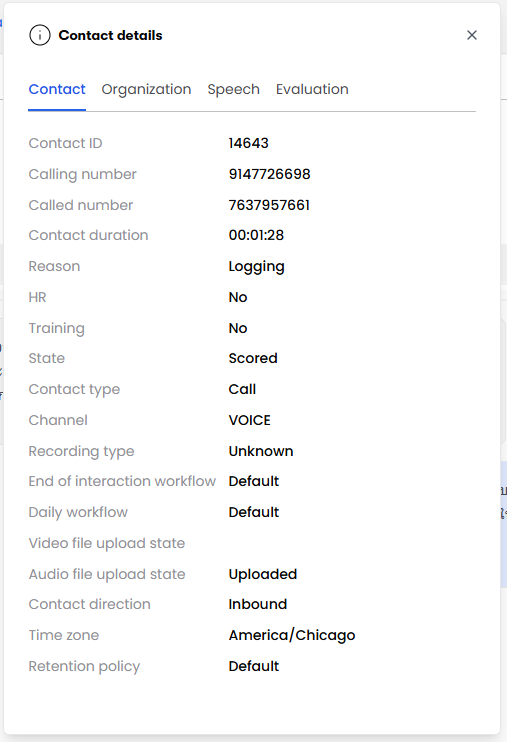
The Contact Details window in the new media player contains many kinds of data associated with the contact. The information available depends on your role, the contact type and contents, and the features your organization uses in Calabrio ONE.
Prerequisites
- Your organization has one of the following licenses:
- Call Recording
- QM
- QM Intelligence
- You have the View Contacts permission.
- Some information requires additional licenses or permissions. The tables below mention these when necessary.
Page location
Interactions > Double-click a contact > View details
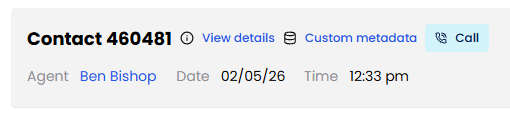
You can also open the Media Player by clicking a contact ID in one of these locations:
- The Agent Explorer page
- The Performance Management home page
- In Insights
- The AI Tags dashboard
- The Auto QM dashboard
- The Trending Topics dashboard
- The Details pane of an Analytics widget
Detail definitions
The Contact details window shows different information depending on the type of contact. Information for calls is different than information for emails, for example. The following tables describe all possible contact data that can appear in the Contact Details panel. Each table orders contact data alphabetically.
Contact tab
| Contact data | Description |
|---|---|
|
Audio file upload state |
The status of the contact’s audio file. Possible values for this field are as follows:
|
|
Called number |
(Calls only) The direct inward dialing (DID) or Dialed Number Identification Service (DNIS) number of the phone that received the call. Displays “unknown” if the called number is unlisted or blocked. |
|
Calling number |
(Calls only) The caller ID or Automatic Number Identification (ANI) of the calling party. Displays “unknown” if the calling number is unlisted or blocked. |
|
Channel |
The channel where the interaction occurred. If the channel is a social media platform, this field appears if your organization uses a supported integration for social media contacts. The possible values for this field vary based on the types of social media your organization uses. |
|
Contact direction |
The direction of the contact: inbound or outbound. |
|
Contact duration |
(Calls only) The length of time between the call being answered and the call being dropped, including ring time and extended screen time (if any) in HH:MM:SS. The call duration is received from the signaling service. The call duration shown in the Contact Duration column on the Interactions page and the media player might not be the same due to the difference in “event duration” (the time between events) and “recording duration” (the duration within the actual recorded file). In these scenarios, the call duration would be different:
|
|
Contact ID |
The conversation’s unique ID. |
|
Contact type |
The contact type. The possible values for this field are:
|
|
Daily workflow |
The name of the Daily Workflow associated with this contact (see Automate QM workflows). |
|
End of interaction Workflow |
The name of the End of Interaction workflow associated with this contact. |
|
External parties |
(Chat and SMS contacts only) The phone number, email address, or other identifier of the person who interacted with the agent. |
|
From address |
(Email contacts only) The email addresses in the From field. |
|
HR |
Indicates if the contact has been marked as an HR contact. |
|
Reason |
The reason the conversation was recorded. This reason is set in the recording rule (see Automate QM workflows). Possible values for this field are listed below. Each organization uses reasons differently, so the definition for each reason might vary based on how your organization assigns reasons.
|
|
Recording type |
The recording type associated with this device. NOTE If the Recording type is Reconciliation, the recording is a root call. A root call is an unreconciled contact. The information in the Recording type field changes when the call is reconciled. See How root calls and reconciliation work |
|
State |
The current evaluation state of the contact. The possible values for this field are:
|
|
Subject |
(Email contacts only) The wording in the Subject line. |
|
Survey name |
The name of the post-contact survey sent to the customer. |
|
Survey score |
The score of a completed post-contact survey. |
|
To address |
(Email contacts only) The email addresses in the To field. |
|
Training |
Indicates if the contact has been marked as a training contact. |
|
Video file upload state |
The status of the video file. Possible values for this field are:
|
Organization tab
NOTE If the Organization tab does not appear, the recording is a root call. A root call is an unreconciled contact. You need the View Root Recordings permission to see root calls. The Organization tab appears when the call is reconciled (see How root calls and reconciliation work).
| Contact data | Description |
|---|---|
|
Agent ACD ID |
The ID of the agent in the ACD. |
|
First name |
The agent’s first name. |
|
Group |
The name of the group that the agent’s team belonged to at the time the contact was recorded. |
|
Last name |
The agent’s last name. |
|
Team |
The name of the team the agent belonged to at the time the contact was recorded. |
Speech tab
| Contact Data | Description |
|---|---|
|
% hold |
The percentage of the call spent in a hold state. |
|
% pause |
The percentage of the call spent in a pause state. |
|
% silence |
The percentage of the call spent in a silence state (during which neither the customer nor the agent is speaking). |
|
% talk over |
The percentage of the call spent in a talkover state (during which both the customer and the agent are speaking). |
|
Hold events |
The number of detected hold events. |
|
Pause events |
The number of detected pause events. |
|
Silence events |
The number of detected silence events. |
|
Talk over events |
The number of detected talkover events. |
|
Total hold duration |
The total duration of hold time in HH:MM:SS format. |
|
Total pause duration |
The total duration of pause time in HH:MM:SS format. |
|
Total silence duration |
The total duration of silence time in HH:MM:SS format. |
|
Total talk over duration |
The total duration of talkover time in HH:MM:SS format. |
Evaluation tab
| Contact Data | Description |
|---|---|
|
Approved by |
The name of the person who approved the evaluation. You can see this information if one of these is true:
|
|
Calibrated |
Whether the contact has been marked for calibration. |
|
Date evaluated |
The date when the contact was evaluated. This date appears if you are the evaluator or if you have the View Evaluator Details permission. If you do not have this permission, ##### appears. |
|
Date responded |
The date the agent responded to the evaluation. |
|
Evaluation form |
The name of the evaluation or calibration form used to score the conversation. |
|
Evaluation response |
The agent's response status for the contact:
|
|
Evaluator name |
The name of the evaluator or calibrator. You can see this information if one of these is true:
|
|
Score |
The evaluation score given to the contact. NOTE Calibration scores do not appear in this field. For calibration scores, use the QM | Evaluator Performance dashboard in Insights. See Interact with Insights dashboards |
Related topics